Bureaucratic and Collaborative Governance in Urban Waste Management: Evidence From Padang City
DOI:
https://doi.org/10.21070/jkmp.v14i1.1963Keywords:
bureaucratic reform, collaborative governance, waste management, institutional, padang city environment agencyAbstract
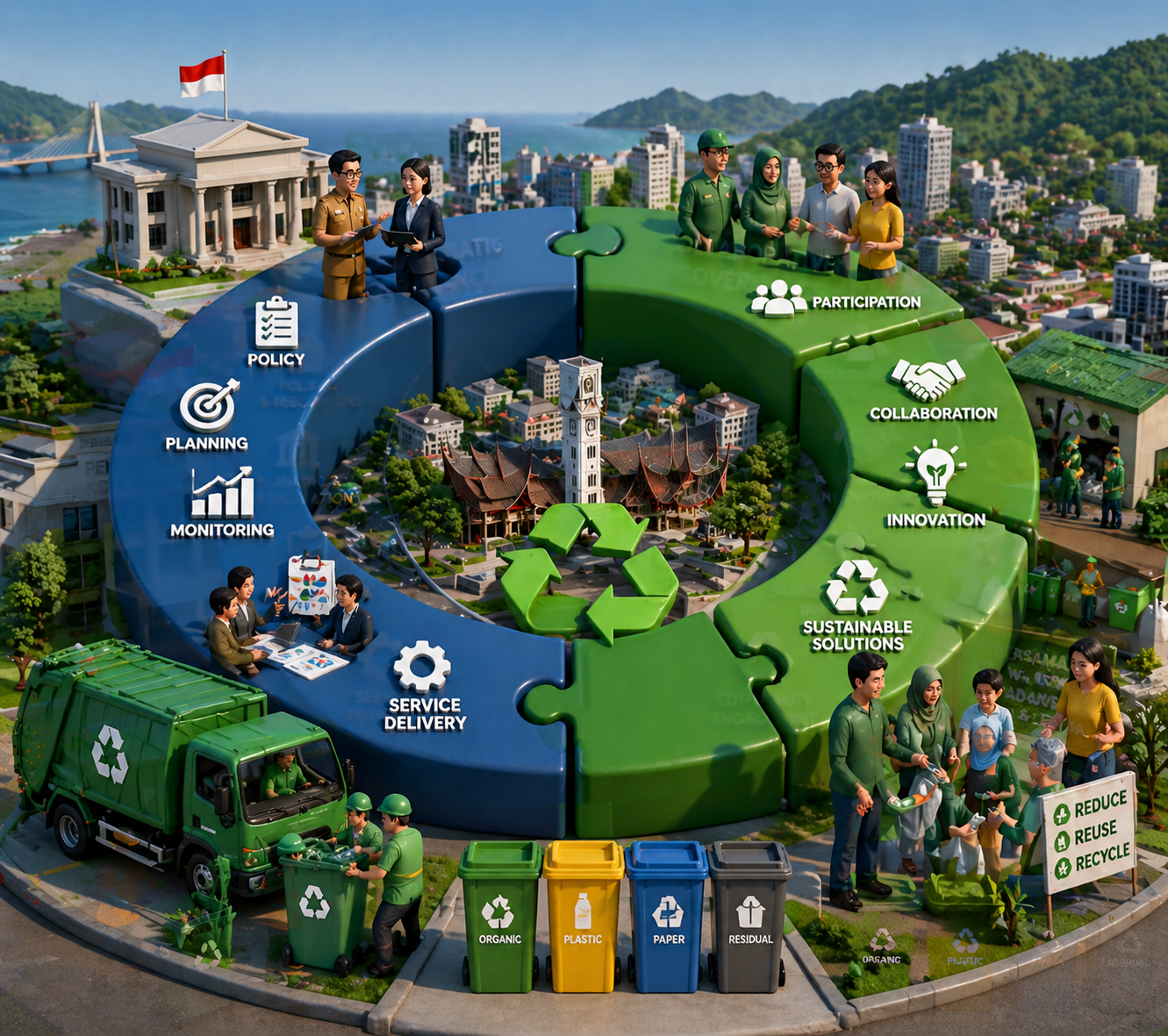
This study analyzes the implementation of bureaucratic reform in the Padang City Environment Agency (DLH) in the context of institutional strengthening and collaborative governance in waste management. The waste issue in Padang City has become increasingly crucial which reaches more than 600 tons per day. Bureaucratic reform is being pursued to strengthen institutions, improve governance, and encourage cross-sector collaboration among government, the private sector, and the community. However, studies examining how regional bureaucratic reform is substantively linked to collaborative environmental governance at the local agency level remain limited. This study employed a qualitative approach with a descriptive phenomenological method and involved 12 informants, consisting of 4 structural officials, 3 functional officials, 2 community leaders, and 3 collaborative partners representing CSR-related institutions and environmental communities. Primary data were obtained through in-depth interviews, while secondary data were collected from policy documents and scientific publications. The results show that bureaucratic reform at DLH remains largely administrative, as reflected in changes in job nomenclature and the use of E-Kinerja to document weekly activities, attendance lists, photographs, and digital reports, which improved accountability but did not fully transform bureaucratic work culture. Cross-sector collaboration has shown positive progress, particularly through CSR support for waste containers and transport facilities and through community participation in waste-related programs, although it remains constrained by limited resources, technical regulations, and inter-actor coordination. This study confirms that institutional reform requires the internalization of performance values and stronger citizen participation to generate substantive impacts on sustainable waste management.
References
Abubakar, I. R., Maniruzzaman, K. M., Dano, U. L., AlShihri, F. S., AlShammari, M. S., Ahmed, S. M. S., Al-Gehlani, W. A. G., & Alrawaf, T. I. (2022). Environmental Sustainability Impacts of Solid Waste Management Practices in the Global South. International Journal of Environmental Research and Public Health, 19(19), 12717. https://doi.org/https://doi.org/10.3390/ijerph191912717.
Alkhuzaim, L., Kouhizadeh, M., & Sarkis, J. (2022). Resource And Natural Resource Dependence Theories in Supply Chains. In Handbook Of Theories for Purchasing, Supply Chain And Management Research. Edward Elgar Publishing.
Ansell, C., & Gash, A. (2018). Collaborative Platforms as a Governance Strategy. Journal of Public Administration Research and Theory: J-PART, 28(1), 16–32. https://doi.org/https://www.jstor.org/stable/48556442
Ansell, C., Sørensen, E., & Torfing, J. (2025). Journal Article Theorizing the Political Dimension of Collaborative Governance. Perspektif on Public Management Anad Governance, 8(3), 158–171. https://doi.org/https://doi.org/10.1093/ppmgov/gvaf007
Aziz, R., Noer, M., & Nurman, A. (2023). Solid Waste Management Strategy for Settlement on A Sloping Hilly Area of Padang City, Indonesia. The 6th Engineering Science and Technology International Conference (Estic 2021): Applied Technology for Sustainable Development, 2691(1), 70007. https://doi.org/https://doi.org/10.1063/5.0115907
Bharti, J. (2023). Effect of improper waste disposal on environmental, physical, and emotional well-being of human beings. In Waste Management and Treatment (pp. 26–38). CRC Press. https://doi.org/10.1201/9781003258377-2
Cairney, P. (2022). The myth of ‘Evidence-Based Policymaking’in A Decentred State. Public Policy and Administration, 37(1), 46–66. https://doi.org/https://doi.org/10.1177/0952076720905016
Eckhard, S. (2021). Bridging the Citizen Gap: Bureaucratic Representation and Knowledge Linkage in (International) Public Administration. Governance, 34(2), 295–314. https://doi.org/https://doi.org/10.1111/gove.12494
Fikry, I., Putra, R. S. F. J., Nindyapuspa, A., Auliya, P. K., Abdillah, H. N., & Wuryaningrum, N. D. (2024). Penanganan Sampah Laut di Indonesia : A Review. JTM: Jurnal Teknologi Maritim, 7(2), 77–87. https://doi.org/https://doi.org/10.35991/jtm.v7i2.40
Hertati, D., Nurhadi, & Tukiman. (2023). Effectiveness of Zero Based Waste Management Policy in Realizing a Clean Gresik Regency. JKMP (Jurnal Kebijakan Dan Manajemen Publik), 11(1), 1–7. https://doi.org/https://doi.org/10.21070/jkmp.v11i1.1738
Jasmine, N., Haludin, G., Widayanto, M. P., Asyifa, Z., Martiza, S. P., & Swangsa, D. (2025). Perubahan Strategis di Perusahaan Fujifilm: Analisis Strategi Manajemen Perubahan Melalui Kotter’s 8 Step Change Model untuk Meningkatkan Kinerja dan Inovasi. J-CEKI : Jurnal Cendekia Ilmiah, 4(2), 1518–1526. https://doi.org/https://doi.org/10.56799/jceki.v4i2.6865
Jiru, C. A., Teklu, T., & Aga, D. A. (2022). Factors Affecting the Use of Performance Information for Decision-Making. Social Sciences and Education Research Review, 9(1), 107–119. https://doi.org/10.5281/zenodo.6794748
Kauppi, K. (2022). Institutional theory. In Handbook of Theories for Purchasing, Supply Chain and Management Research. Edward Elgar Publishing.
Kristanto, G. A., Kemala, D., & Nandhita, P. A. C. (2021). Challenges Confronting Waste Pickers in Indonesia: An on-Field Analysis. Waste Management & Research: The Journal for a Sustainable Circular Economy, 40(9), 1381–1389. https://doi.org/https://doi.org/10.1177/0734242X211029181
Lapsley, I. (2022). Whatever happened to New Public Management? Financial Accountability & Management, 38(4), 471–482. https://doi.org/https://doi.org/10.1111/faam.12346
Leknoi, U., Painmanakul, P., Chawaloesphonsiya, N., Chawaloesphonsiya, N., & Wimolsakcharoen, W. (2024). Building Sustainable Community: Insight From Successful Waste Management Initiative. Resources, Conservation & Recycling Advances, 24, 1–11. https://doi.org/10.1016/j.rcradv.2024.200238
Mujahidin, & Kusuma, F. K. (2025). Redesigning Bureaucracy as a Governmental Strategy for Enhancing Public Service Effectiveness. Society, 13(1), 803–817. https://doi.org/https://doi.org/10.33019/society.v13i1.766
Pakasi, U., Anirwan, & Kamaluddin, S. (2025). Reimagining the Bureaucracy and Post-Bureaucracy Debate: A Review on Paradoxes in Public Administration. JPP: Journal of Public Policy, 1(1), 46–59.
Putra, W. T., & Ismaniar. (2020). Community Empowerment Through Waste Management At the Waste Bank. Jambura Journal of Community Empowerment (JJCE), 1(2), 69–78. https://doi.org/https://doi.org/10.37411/jjce.v1i2.569
Rahayu, S. D., & Nurjannah, A. E. (2025). Collaborative Governance in Empowering Women in Coastal Areas in Bekasi Regency. Priviet Social Sciences Journal, 5(10), 59–69. https://doi.org/https://doi.org/10.55942/pssj.v5i10.649
Rahman, T., Alam, M. Z., Moniruzzaman, M., Miah, M. S., Horaira, M. A., & Kamal, R. (2024). Navigating the Contemporary Landscape of Food Waste Management in Developing Countries: A Comprehensive Overview and Prospective Analysis. Heliyon, 10(12), 1–25. https://doi.org/https://doi.org/10.1016/j.heliyon.2024.e33218
Rahmi, N., & Ernawati. (2021). Perilaku Ibu Rumah Tangga Dalam Pengelolaan Sampah di Kecamatan Pauh Kota Padang. Jambura Geo Education Journal, 2(1), 1–6. https://doi.org/https://doi.org/10.34312/jgej.v2i1.7153
Sutiyoso, B. U., & Faedlulloh, D. (2024). Navigating Social Capital Development Through Organisational Citizenship Behaviour in Local Government Bureaucracy. Cogent Social Sciences, 10(1), 1–14. https://doi.org/https://doi.org/10.1080/23311886.2024.2386708
Valentina, T. R., Putera, R. E., & Purnama, T. H. (2025). Harmonizing Pancasila Principles with Collaborative Governance Politics for Sustainable Waste Management in Padang. International Journal of Environmental Impacts, 8(5), 865–875. https://doi.org/https://doi.org/10.56578/ijei080503
Voukkali, I., Papamichael, I., Loizia, P., & Zorpas, A. A. (2024). Urbanization and Solid Waste Production: Prospects and Challenges. Environmental Science and Pollution Research, 31(12), 17678–17689.
Downloads
Published
License
Copyright (c) 2026 Tirza Haqia Purnama, Roni Ekha Putera, Nika Saputra, Edi Hasymi, Aqil Teguh Fathani, Tengku Rika Valentina, Nabilaa Binti Mohamed

This work is licensed under a Creative Commons Attribution 4.0 International License.