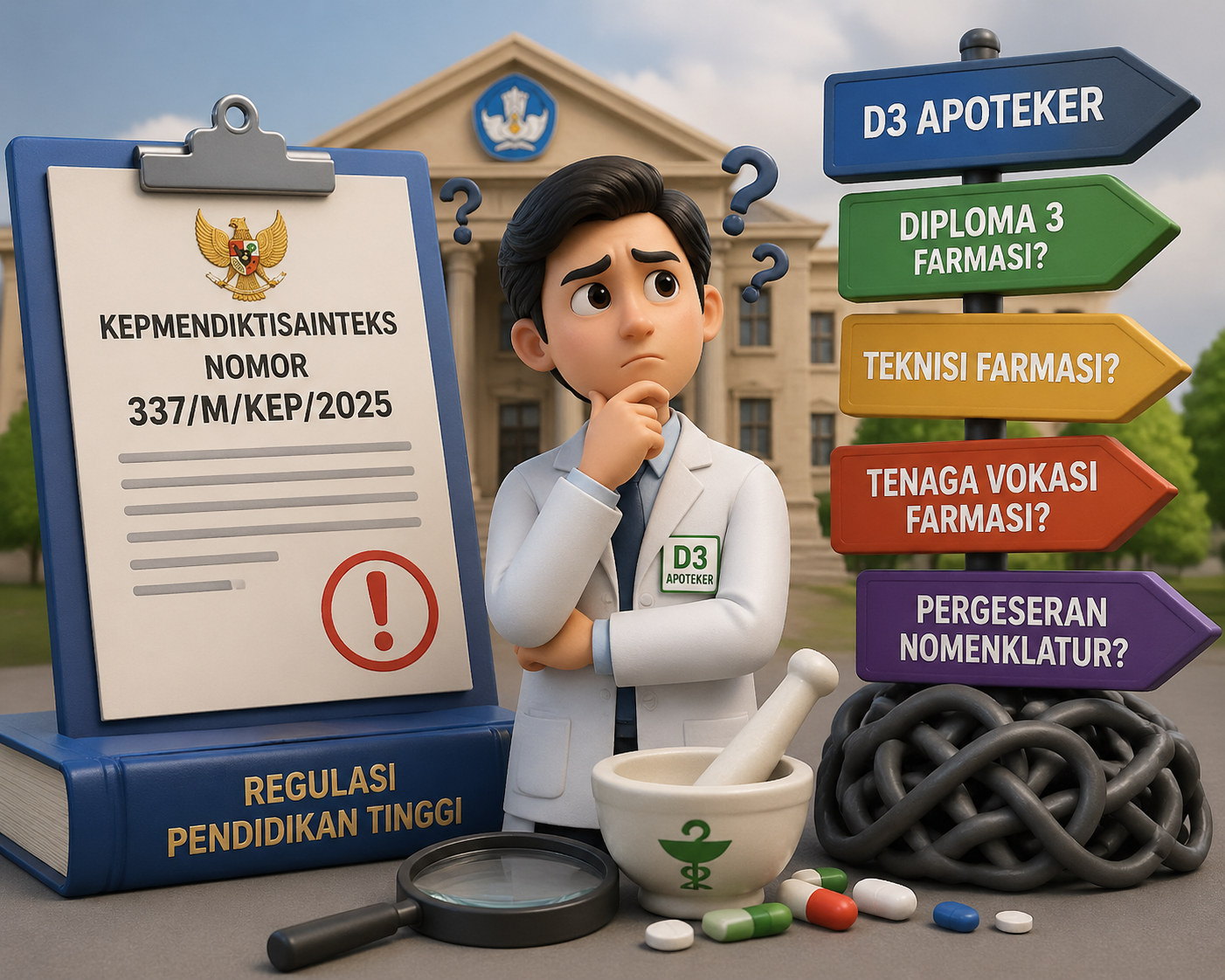
Issues Regarding the Nomenclature of D3 Pharmacist in KEPMENDIKTISAINTEKS Number 337/M/KEP/2025
Problematik Nomeklatur D3 Apoteker dalam KEPMENDIKTISAINTEKS Nomor 337/M/KEP/2025
DOI:
https://doi.org/10.21070/jkmp.v14i1.2068Keywords:
policy incoherence, professional educational, vocation pharmacy, regulatory harmonization, health workforce govermenceAbstract
The issuance of Decree No. 337/M/KEP/2025 concerning Higher Education Providers for Medical and Health Personnel Conducting Competency Tests has sparked controversy due to the use of the nomenclature "D3 Pharmacist". Conceptually and normatively, the term combines the vocational education level (Diploma III) with a professional degree, which in the national higher education and health legal system is placed at the professional education level. This study aims to analyze the problematic nomenclature and its implications for legal certainty, regulatory coherence, and governance of the pharmaceutical profession. The study used a qualitative approach with a literature study method. Data were obtained from relevant laws and regulations, policy documents, and scientific articles, then analyzed using the Miles and Huberman interactive model through the stages of data reduction, data presentation, and conclusion drawing. The results show that the use of the term "D3 Pharmacist" is not aligned with the national qualification framework and regulations that clearly differentiate vocational and professional education. This inconsistency creates regulatory ambiguity, risks double interpretation in policy implementation, and disrupts the formation of professional identity. Furthermore, this contributes to scope-of-practice confusion, weakens licensing and degree protection mechanisms, and creates a legitimacy gap in the healthcare workforce. Therefore, immediate regulatory harmonization is crucial to ensure legal clarity, protect professional standards, and maintain the quality of healthcare services.
References
Abualhasan, M., Tahan, S., Nassar, R., Damere, M., Salameh, H., & Zyoud, H. (2023). Pharmacists’ knowledge of drug food administration and their appropriate patient counseling a cross-sectional study from Palestine. Journal of Health, Population and Nutrition, 42(99), 1–9. https://doi.org/10.1186/s41043-023-00444-9
Alzamanan, A. M., Almareh, N. F., Alyami, A. A. M., Al-Yami, A. A. M., Alghamdi, B. S., Theban, S. K. A. Al, Alyami, N. M. H., Alsaiari, A. A. S., Motared, A. M. S. Al, & Alsawatt, M. E. M. (2024). The Role of Healthcare Workers in Modern Medicine: A Comprehensive Review of Challenges, Contributions, and Future Directions. Journal of Ecohumanism, 3(7), 2670–2681. https://doi.org/10.62754/joe.v3i7.4666
Assyakurrohim, D., Ikhram, D., Sirodj, R. A., & Afgani, M. W. (2022). Metode Studi Kasus dalam Penelitian Kualitatif. Jurnal Pendidikan Sains Dan Komputer, 3(1), 1–9. https://doi.org/10.47709/jpsk.v3i01.1951
Cokro, F., Atmanda, P. F. K., Sagala, R. J., Arrang, S. T., Notario, D., Rukmini, E., & Aparasu, R. (2021). Pharmacy Education In Indonesia. Pharmacy Education, 21, 432–442. https://doi.org/10.46542/pe.2021.211.432442
Cruess, S. R., Cruess, R. L., & Steinert, Y. (2019). Supporting the development of a professional identity: General principles. Medical Teacher, 41(6), 641–649. https://doi.org/10.1080/0142159X.2018.1536260
Dering-Anderson, A. M., Blaha, M. E., & Neville, J. L. (2020). Defining the Role of the Advanced Pharmacy Technician: Perspective Dissonance. Journal of Pharmacy Technology, 36(6), 223–230. https://doi.org/10.1177/8755122520947637
Heidari, E., Zalmai, R., Richards, K., Sakthisivabalan, L., & Brown, C. (2023). Z-code documentation to identify social determinants of health among Medicaid beneficiaries. Research in Social and Administrative Pharmacy, 19(1), 180–183. https://doi.org/10.1016/j.sapharm.2022.10.010
Howle, A., Carter, G., & Reising, D. (2025). Contemporary Factors Influencing Professional Identity in Acute Care Nurses: An Integrative Review. Journal of Advanced Nursing, 81(10), 6134–6154. https://doi.org/10.1111/jan.16755
Isnawati. (2022). Reconstruction Of The Legislation Hierarchy In Law 12 Year 2011 Based On The Values Of Pancasila Justice. Constitutional Law Society, 1(1), 50–61. https://doi.org/10.36448/cls.v1i1.7
Knoer, S. J., Eck, A. R., & Lucas, A. J. (2016). A review of American pharmacy: education, training, technology, and practice. Journal of Pharmaceutical Health Care and Sciences, 2(32), 1–7. https://doi.org/10.1186/s40780-016-0066-3
Láncos, P. L. (2023). Linguistic Challenges of Interoperable Registers in the Context of E-Government Services. Pázmány Law Review, 10(1), 7–11. https://doi.org/10.55019/plr.2023.1.7-11
McLaughlin, K., Joyal, K., Lee, S., Corrado, M., Marquis, K., Anger, K., & Szumita, P. (2020). Safety of intravenous push thiamine administration at a tertiary academic medical center. Journal of the American Pharmacists Association, 60(4), 598–601. https://doi.org/10.1016/j.japh.2019.12.005
Mizranita, V., Sim, T. F., Sunderland, B., Parsons, R., & Hughes, J. D. (2021). The Pharmacists’ and pharmacy technicians’ scopes of practice in the management of minor ailments at community pharmacies in Indonesia: a cross-sectional study. Pharmacy Practice, 19(2), 2295. https://doi.org/10.18549/PharmPract.2021.2.2295
Newman, E. M., Haas, A. F., Levin, P. R., Menor, C. M., & Hernandez Conte, A. (2026). Patient Understanding of Health Care Practitioner Titles—A California Survey. Dermatologic Surgery, 52(3), 273–277. https://doi.org/10.1097/DSS.0000000000004807
Presiden Republik Indonesia. (2023). Undang-Undang Republik Indonesia Nomor 17 Tahun 2023 tentang Kesehatan. Lembaran Negara Republik Indonesia Tahun 2023 Nomor 105. Jakarta: Sekretariat Negara
Qomaruddin, Q., & Sa’diyah, H. (2024). Kajian Teoritis tentang Teknik Analisis Data dalam Penelitian Kualitatif: Perspektif Spradley, Miles dan Huberman. Journal of Management, Accounting, and Administration, 1(2), 77–84. https://doi.org/10.52620/jomaa.v1i2.93
Downloads
Published
License
Copyright (c) 2026 Syaripah Ulandari, Made Laksmi Meiliana, Dwi Ismayati

This work is licensed under a Creative Commons Attribution 4.0 International License.